







Industry 4.0 is driven by the intelligent integration of data and real-time connectivity. However, the true value of this revolution lies in the ability to act upon the information at the exact moment it is generated.
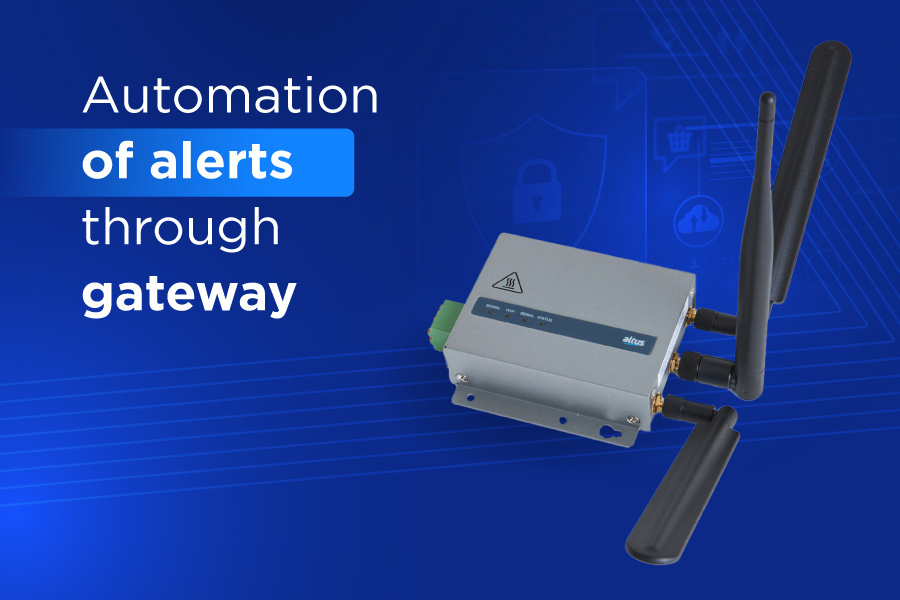
In industrial environments, faults not detected in time can generate anomalies with severe consequences. With this in mind, our IoT gateway TLE, part of the Connect Series, was developed to act by transforming raw data into precise and actionable alerts, eliminating the "silence" that precedes operational disaster.
Follow this article and understand how alert automation can transform operations monitoring, increasing the efficiency of fault prevention and protecting professionals at every stage of the process.
Unscheduled downtime: the silent enemy of productivity
Industrial productivity is directly linked to the reliability and availability of assets. Unplanned interruptions become the biggest enemies of efficiency, bringing losses that can reach alarming proportions.
Global research indicates that an unexpected shutdown can cost up to US$125 thousand per hour — and, in high-risk and high-complexity sectors, such as manufacturing and transport, this value can exceed US$5 million per hour.
And these costs go far beyond the immediate loss of production; they include recovery expenses, equipment damage, risks to operator safety, contractual fines, and damage to the company's reputation. Therefore, the speed of problem detection turns into a critical performance indicator.
Maintenance guided by real-time monitoring is based on the anticipation of failures.By observing the mechanical and operational conditions of the assets, it is possible to maintain an interval between maintenance actions, reducing both the frequency and cost of downtime. Using an IIoT device, such as the TLE, data is processed and transformed into alerts in a matter of milliseconds, ensuring an immediate reaction, which can represent the difference between a low-cost preventive repair and a catastrophic failure.
When the cost of inactivity can be quite high, depending on the size of the operation, eliminating any delay in notification generates an immediate return on investment.
The TLE event system features the function Delay to Send, that enables configuring the delay time for sending notifications. By reducing this interval from 60 seconds to zero, the administrator can decrease the time for incident detection, optimizing the speed of operational response and reducing the impact of failures on the process.
Why receive alerts via e-mail or SMS in industrial operations?
Even with the use of modern industrial protocols, such as Modbus and MQTT, traditional communication channels, such as email and SMS, remain indispensable to ensure that alarms and notifications reach the right operator, at the right time, regardless of where they are.
The E-mail serves as the main integration channel between Operational Technology (OT) and Information Technology (IT) systems. It is the ideal means for sending detailed logs, fault reports, and formal notifications that require traceability.This allows the teams involved to have access to a complete history of anomalies for analysis and continuous process improvement.
SMS, on the other hand, is the ideal channel for critical alerts, as it ensures immediate and direct communication, which is fundamental in cases of security failures or process interruptions.
The TLE supports SMS functionality through its Cellular ToolkitIn industrial scenarios where the IP data network may be congested or failing, SMS operates depending only on the cellular operator's infrastructure. This communication capability is very useful, including for remote management, because it is a function that ensures the operator is always connected to the factory floor.
Robust hardware and connection redundancy
The construction of the TLE is robust, in a metal alloy casing that provides IP30 protection and resistance to operate in rigorous environments. The device supports a wide operating temperature range, from -30°C to 70°C. In terms of interfaces, it offers the necessary connectivity to integrate new and legacy assets:
- – Network interfaces: 1 10/100Mbps Ethernet port (LAN/WAN) and Wi-Fi IEEE 802.11 b/g/n (1T1R) support.
- – Field interfaces: 1 configurable serial port (RS-232/RS-485), including 1x digital input (DI) for sensors and 1 digital output (DO) of 24V/300mA (relay) for activating external alarms.
And besides these features, the TLE was developed to offer high WAN connection resilience. The equipment integrates a Dual SIM LTE Module, which guarantees redundancy between SIM cards and maintains stable communication even in the event of failure in one of the operators. This system mitigates the risks of interruption, ensuring that data traffic, whether Modbus, MQTT, or another protocol, remains stable and that alert channels (email and SMS) continue operating. The administrator can configure the Preferred SIM Card with the Failback option, allowing the system to automatically return to the main SIM card as soon as the connection is restored.
This flexibility enables an intelligent availability management, where the primary SIM operates normally with the chosen carrier, while the secondary SIM remains in standby as a contingency option.
In case of failure of the primary connection, the automatic switch to the secondary SIM drastically reduces downtime. When the primary connection is restored, Failback ensures the return to the main SIM card, balancing high availability and optimization of operational costs, avoiding, for example, the continuous use of a backup carrier in roaming.
Protocols and open architecture to create communication bridges
The TLE is capable of communicating with all levels of an architecture. It operates as a multiprotocol converter, supporting both factory floor industrial traffic (OT) and management traffic (IT).
On the OT side, it supports:
- – Modbus: it acts as a gateway for MODBUS TCP/RTU/ASCII (Client/Server).
- – MQTT: it enables the publication and subscription of messages (MQTT Subscriber & Publisher), a lightweight protocol ideal for narrow-band IoT.
- – Serial-Ethernet: the feature Virtual COM mode (RFC2217, TCP Client/Server, UDP) enables legacy systems based on serial communication to be virtualized and accessible via IP network.
On the TI side, it supports:
- – VPN: robust VPN technology (IPSec, OpenVPN, L2TP, GRE), with capacity for up to 3 simultaneous tunnels.
- – Remote management: compatible with SNMP, CLI, and TR-069, the TLE allows the operator to monitor, configure, and execute adjustments securely, standardized, and completely remotely, from anywhere.
The TLE also has cybersecurity as one of the central pillars of its architecture. The equipment integrates an SPI Firewall and an IPS (Intrusion Prevention System), which are fundamental for protecting the gateway when it is exposed to the internet via cellular WAN. The IPS can be configured to detect and block attack packets, ensuring that data traffic and alert channels remain confidential and protected. In this way, the TLE becomes a secure remote access point, capable of preserving the integrity of communications.
Profiles, managerial events, and notifiers
To use the event function, the administrator must first activate the function in Service > SMS & Event > Configuration. The architecture is based on two types of events, each with specific triggers and actions:
Notifier events: the main objective is to continuously monitor operations and alert the administrator about any status change, ensuring quick responses.
- – Triggers: they include Digital Input (DI), Power Change, Connection Change (WAN/WiFi/DDNS), Administration (system events), Modbus (register anomalies), and Data Usage (limit excess).
- – Actions: the responses are focused on communication: SMS, Syslog, SNMP Trap, Email Alert, MQTT Publication, and control actions such as activating the Digital Output (DO) or writing to Modbus registers.
Managerial events: these events are used to administer the system or perform configuration and status changes remotely, offering greater control.
- – Triggers: SMS, SNMP Trap, or Digital Input (DI).
- – Actions: the responses are direct system control actions, such as configuring LAN/VLAN, turning WiFi/VPN/Firewall on/off, executing Reboot, Restore Config commands, or performing a write (control) to Digital Output (DO) or Modbus devices.
Additionally, the event system operates based on pre-configured profiles, which define the specific logic for each field device, determining when and how alerts or actions will be triggered, using the following resources:
- – DI Profile Configuration: The Digital Input (DI) Profile Configuration is essential for the quality of physical sensor alerts. It allows defining the Normal Level (Low or High) and the signal activation time (Signal Active Time). By requiring the signal to remain active for a minimum period, the system prevents false alarms caused by electrical noise or power fluctuations in the machine.
- – Modbus Profile Configuration: The Modbus Notifying Events Profile is the basis for predictive maintenance and variable monitoring. It allows the administrator to define: the reading function; the target Device ID and Register; the Logic Comparator and the reference Value.
This profile structure ensures that alerts are generated based on the application logic, and not just connectivity, providing more precise and relevant notifications for each operational context.
How the configuration of alerts via e-mail works
See how e-mail alert configuration is done:
- External server configuration: the administrator must configure an e-mail Server profile in Object Definition > External Server. This configuration requires filling in parameters such as Server IP/FQDN or Server Port, and authentication credentials (username and password).
- Service account creation: an e-mail service account is created in Service > SMS & Event > Configuration. This account links the gateway to the configured SMTP server (External Server) and defines the destination email address.
- Definition of the action: in Notifying Event Configuration, the administrator selects the E-mail Alert action, ensuring that the trigger (for example, WAN failure or Modbus alarm) fires the notification to the defined recipients.
This modular architecture provides flexible administration, allowing the administrator to strategically configure the alert structure. Thus, the system can attempt to send the notification through a primary SMTP server and, in case of failure, automatically trigger a secondary server, ensuring reliable message delivery.
How remote command via SMS works
The SMS configuration requires the activation of the cellular module, which operates as the following features:
- Priority alert (notification): SMS is activated as an Action in the Notifying Event, ensuring that critical events (such as the triggering of a DI sensor or a WAN connection failure) fire messages to the phone numbers defined in the SMS Account Configuration.
- Bidirectional control (management): a powerful TLE feature that enables a received SMS to be used as a trigger for a Managing Event. The administrator, from anywhere, can send a text command to the gateway, and it executes a system control action.
For example, if a Managing Event is configured to be triggered by receiving an SMS with the text “REBOOT”, the administrator can remotely reboot the device, resolving software or connectivity issues without the need for a VPN or web access. Security is guaranteed by the option to configure a mandatory Message Prefix to validate the received SMS, preventing management commands from being triggered by unauthorized messages.
Another example is the application of the TLE Event Manager, which can be observed in practical scenarios focused on the most recurrent failures, such as:
Scenario: unexpected communication link failure
In remote installations, where the operation depends on a single cellular operator, any connection failure can isolate machines and interrupt the data flow. It's like being on an island, dependent on a single bridge to communicate with the world.
For these cases, the TLE is equipped with a Dual SIM Failover to ensure that operation continues even when the main connection drops. Upon detecting the loss of link on WAN-1, the system automatically transfers all IP traffic, including Modbus TCP, MQTT, and VPN, to WAN-2, the backup SIM. The result is almost instantaneous: communication remains active, downtime is minimized, and the application remains visible, even in remote locations.
At the same time, the TLE triggers an E-mail Alert through a Notifying Event, informing the team that the backup SIM has taken over. This notification is crucial: it allows the team to quickly contact the operator and resolve the issue, preventing a small incident from turning into a total shutdown.
The TLE thus transforms a potential vulnerability into a reliable operation, where the system is ready to react before the impact becomes critical.
Scenario 2: prevention of equipment failure
The useful life of an asset can be reduced due to undetected failures, such as the gradual increase in a motor's temperature.
This is where the TLE comes into play. Through a monitoring profile configured as Modbus Notifying Events, the system begins to closely watch the motor's signals. The Read Holding Registers continuously read the data sent by the PLC, recording every temperature variation. A Logic Comparator analyzes these readings and, upon detecting that the safe limit has been exceeded, triggers the first alert: an urgent SMS is sent, warning that something is out of the ordinary.
Almost simultaneously, the notifying event triggers a Modbus Managing Event, programmed to send a Write Single Register back to the PLC. In a matter of seconds, the controller executes a corrective action: it initiates a controlled shutdown process or activates an auxiliary cooling system, protecting the equipment before damage occurs.
This ability to transform a simple reading into a coordinated and automatic response makes the gateway much more than a data collector. It becomes an edge controller, essential for the automation of active predictive maintenance.
Scenario 3: critical local power failure or security failure
At some point during operation, a power failure may occur in a control panel or a security door may be opened unexpectedly. In these cases, there is no time to lose: the reaction must be immediate, and not just digital—a physical event needs to happen to protect people and equipment.
This is where the TLE's digital input and output automation comes in. Every event is monitored precisely. For example, when the Modbus address detects that the logic level has changed, the system instantly triggers a Notifying Event.
The event sends Syslog records, ensuring compliance and traceability, and publishes information via MQTT to the cloud, keeping all data accessible and auditable. Simultaneously, the event triggers a Digital Output physically connected to an emergency light or siren, ensuring that the alert is noticeable even without screens or notifications.
With this combination of digital monitoring, physical response, and remote control, the TLE transforms every alert into an immediate action, ensuring that critical failures never go unnoticed and that the plant remains protected and connected.
Ensuring this layer of intelligence and security has never been so simple.
As part of our commitment to democratizing technologies for intelligent automation, we want to make this solution accessible to you. Therefore, the TLE is available under special promotional pricing conditions, valid until the end of October (or while supplies last); an opportunity to strengthen the future of your automation.