







In today's global landscape, the industry is undergoing a profound and accelerated transformation. The concept of Industry 4.0, which previously appeared as a futuristic vision in corporate presentations, has become an immediate requirement in the industrial environment, redefining practices, technologies, and operational models on the factory floor.
However, this digital transformation brings a technical challenge that has persisted for decades: ensuring interoperability and standardization in communication between systems. It is precisely in this scenario that the EtherNet/IP protocol stands out as one of the most relevant solutions, combining the deterministic reliability required in critical applications with the flexibility of communication based on the Ethernet standard, two indispensable elements for enabling the implementation of the Industrial Internet of Things (IIoT).
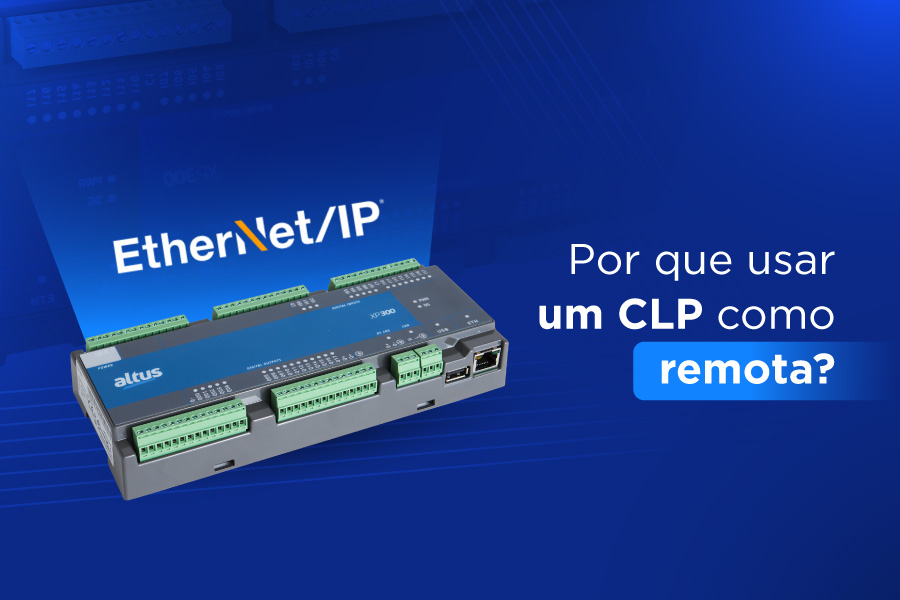
Altus, recognized for its excellence and innovation in the automation market, meets this critical demand with a strategic update to its line of compact controllers: a inclusão do protocolo Ethernet/IP no modo E/S Remoto nos modelos XP300, XP315 e XP325 da família Nexto XP. This mode allows the controller to be used as a non-programmable remote I/O device, redefining the design of modern architectures by enabling system decentralization and reducing infrastructure costs.
This article delves into this new functionality, presenting the fundamentals of the EtherNet/IP protocol, its practical implementation, and the benefits in industrial automation architecture. We will discuss how the hardware and software features of Nexto XP controllers enhance the use of the protocol, creating more robust solutions by using the PLC as an intelligent remote to simplify complex topologies and optimize integrations.
Understanding the EtherNet/IP protocol
Para compreender a dimensão do impacto da implementação do EtherNet/IP nestes controladores na Nexto XP series, it is essential to first clarify the protocol itself.
EtherNet/IP corresponds to one of the forms of implementation of the Common Industrial Protocol (CIP). This protocol is based on open standards that serve as a mandatory reference for automation systems. The organization responsible for developing CIP is the ODVA, which manages four industrial technologies: EtherNet/IP, DeviceNet, ControlNet, and CompoNet.
In practical terms, EtherNet/IP uses the same physical infrastructure as the Ethernet network found in residential and corporate environments, which facilitates its adoption without the need for additional cabling. The term “IP” refers to Industrial Protocol, highlighting that it is a protocol geared toward industry and not the traditional TCP/IP protocol used in internet data traffic.
This means that the same cables, routers and, above all, the same networking knowledge used in corporate environments can be applied to the factory floor, but, naturally, taking into account the additional requirements of industrial robustness.
Learn more: Nexto XP: your gateway to operate in the IoT universe
Understanding the CIP protocol
CIP (Common Industrial Protocol) is an object-oriented application layer protocol that defines not only how data travels, but also how devices represent themselves, behave, and interact on the network.
It works as a unifying layer, independent of the physical medium. The same CIP object that defines a motor drive profile on a DeviceNet network is used on EtherNet/IP. This ensures operational consistency: when the Nexto XP communicates via EtherNet/IP, it does not send raw packets of bytes; it exchanges structured data objects (Classes, Instances, and Attributes). This enables functionalities such as:
- – Real-time control: the guarantee of delivery of critical data for motion control and machine safety.
- – Device configuration: the ability to remotely parameterize sensors, inverters, and controllers through the network.
- – Information gathering: access to detailed diagnostics, fault logs, and operation status, essential for predictive maintenance.
The implementation of CIP in the Nexto XP means that the controller adopts a standardized data structure, facilitating its integration with devices from hundreds of other manufacturers that follow the same standard.
The Producer/Consumer mode: bandwidth efficiency
Uma das contribuições mais relevantes do EtherNet/IP para uma arquitetura com Nexto XP architecture is the adoption of the Producer/Consumer communication model.
In conventional fieldbus networks, structured around Master/Slave (such as Modbus RTU) or Client/Server (such as Modbus TCP) paradigms, traffic tends to be less efficient when there is a large volume of information. This occurs because the master must make individual requests to each slave device. In this scenario, if more than one controller simultaneously requires the data generated by a critical sensor, that device will have to respond repeatedly, creating a higher load on the network and increasing system latency.
In the Producer/Consumer model supported by EtherNet/IP, it is possible to:
- – The “Producer” device (in this case, the Nexto XP configured as an Adapter reading its inputs) publishes the information to the network using multicast.
- – Multiple “Consumers” (other PLCs, HMIs, supervisory systems, or edge gateways) receive this information simultaneously without generating additional traffic at the source.
This mechanism optimizes network bandwidth usage and enables more precise synchronization between distributed processes. In the case of the Nexto XP seriesdesigned for applications that require high speed, this means that the same input signals can be used simultaneously by a PLC responsible for central control and by a performance monitoring system, without any negative impact on the control cycle time.
Learn more about the XP family in this success case: Toll optimization for higher operational efficiency with Nexto XP technology
TCP vs. UDP
The robustness and flexibility of EtherNet/IP, now accessible through XP controllers, lie in its ability to manage two distinct types of network traffic simultaneously, using the standard ports of the IP stack:
- – Implicit messages (I/O Messaging – UDP/IP): are real-time control data messages. Imagine the state of a critical digital input or the speed command for a servo motor. These data are called “implicit” because the meaning of the data (what each bit represents) is predefined during the connection configuration and does not need to be retransmitted in every packet. The focus here is speed, low latency, and support for real-time applications. Nexto XP PLCs use the UDP (User Datagram Protocol) for these messages. UDP is a protocol that does not require an acknowledgment for each packet, making it much faster for cyclic data that is constantly updated (for example, every 10 milliseconds).
- – Explicit messages (Explicit Messaging – TCP/IP): are used for configuration, diagnostics, program upload/download, and non-critical data exchange. When it is necessary to change a configuration parameter of an analog module, for example, an explicit message using TCP (Transmission Control Protocol) is used. TCP is connection-oriented and ensures the correct delivery of information, retransmitting packets if there is a loss in the network.
Scanner and Adapter: defining roles in the architecture
In the topology of an EtherNet/IP network, devices assume clear hierarchical roles:
- – Scanner (Client/Master/Originator): é o dispositivo “iniciador” da comunicação. Ele detém a configuração das conexões, define os intervalos de troca de dados (RPI – Requested Packet Interval) e gerencia a rede. Geralmente, é o CLP principal que controla o processo lógico da máquina.
- – Adapter (Server/Slave/Target): is the device that “responds” to the scanner's requests. It makes its input data available and accepts output data. Sensors, valves, and frequency inverters are typically adapters.
Essa versatilidade abre espaço para arquiteturas modulares: um controlador Nexto XP pode atuar como scanner, ou operar como um Adapter fornecendo informações a um sistema supervisório ou sendo controlado por um outro CLP hierarquicamente superior. Vale destacar, contudo, que that the central goal of the “Remote Mode” feature is to enable the PLC to act as an independent remote I/O device,capable of operating without the need for programming via the MasterTool tool.
O Nexto XP no modo adapter: por que usar o CLP como remota?
Traditionally, the expansion of I/O points in machines and processes has been done through passive bus couplers, whose function is limited to digitizing and relaying signals. However, with the advancement of Industry 4.0 and the increasing demands for availability and reliability, this approach is no longer sufficient.
By employing a Nexto XP as an EtherNet/IP remote, significant benefits emerge compared to conventional remotes, including:
- – Edge Processing: In this mode, the XP acts exclusively as an Adapter, limited to reading inputs and writing outputs. In the event of a loss of communication with the Scanner (central PLC), the controller enters STOP mode, behaving equivalently to a traditional I/O remote. Edge Processing only becomes valid when the XP is running its own application project and, within this project, an EtherNet/IP Adapter is instantiated in the network. In this scenario, the XP's CPU remains active, enabling the execution of local logic, such as fast interlocks, signal processing, high-speed counting, or safety strategies defined in the project. Thus, even if communication with the Scanner is lost, the XP can maintain autonomous behaviors defined in the project.
- – Cabling reduction: By positioning the XP close to the sensors and actuators and connecting it via a single Ethernet cable to the main panel, copper cables are saved, and installation labor and the risk of wiring errors are minimized.
- – Rich diagnostics: the XP provides detailed diagnostics via system variables and physical LEDs. In Adapter mode, this diagnostic information (short circuits on outputs, sensor failure) is mapped into status bytes sent via EtherNet/IP to the central system, facilitating predictive maintenance and rapid fault location.
- – Flexibility and cost-benefit: In many applications, the cost of an XP (which already integrates CPU, power supply, and I/O into a single device) is very competitive compared to the combined cost of a modular network head + power supply + I/O cards, especially for low to medium point counts.
- – Cybersecurity and integrated firewall:In the current era of hyper-connectivity, integrating PLCs directly into the Ethernet network also exposes them to a set of cyber threats. Since EtherNet/IP operates on top of the TCP/IP stack, it is subject to the same risks as any connected device if adequate protection mechanisms are not in place. Nexto XP controllers stand out in this regard by incorporating a native firewall, configured through their web interface. This feature allows for the implementation of white-listing filtering rules, defining exactly which devices can exchange data via EtherNet/IP.
A recommended practice is to authorize only the Scanner to access TCP port 44818 (explicit traffic) and UDP port 2222 (implicit traffic). In this way, any access attempt or scan made by unrecognized IP addresses is automatically blocked, ensuring that only the legitimate controller has the ability to act on the machine's outputs.
Multiple protocols in the same environment
A interface Ethernet do Nexto XP é multiprotocolo. O hardware robusto permite que o dispositivo execute o protocolo EtherNet/IP (para controle em tempo real) simultaneamente com outros protocolos na mesma porta física RJ45. Isso habilita arquiteturas de dados paralelas, como:
- – EtherNet/IP + OPC UA: While EtherNet/IP exchanges fast control data (milliseconds) with the central PLC, the integrated OPC UA server in the XP can provide contextualized, historical, and secure data directly to an MES, SCADA, or cloud ERP system.
- – EtherNet/IP + MQTT: For telemetry and IIoT applications, the XP can act as a control remote and, at the same time, publish selected data via MQTT protocol to a cloud broker (AWS, Azure, etc.). The XP thus acts as an intelligent IIoT gateway for the sensors connected to it.
This "polyglot" capability makes XP controllers function as an integration link between the operational technology (OT) of the factory floor and highly connected information technology (IT) networks and systems.
What we have demonstrated throughout this article is that the a incorporação do suporte ao modo de E/S Remota via EtherNet/IP nos controladores XP300, XP315 e XP325 da família Nexto XP representa um marco de maturidade tecnológica e de alinhamento estratégico da Altus às demandas globais da automação industrial. By adopting one of the most consolidated and widely spread industrial protocols on the market, Altus eliminates communication barriers that traditionally limited the application of compact controllers in large-scale industrial architectures, significantly expanding their potential for use, integration, and competitiveness.
The possibility of functioning as an Adapter (remote) makes the use of smart I/O more accessible, allowing engineers and integrators to design distributed and highly reliable architectures where processing occurs at the edge (edge computing) and communication flows seamlessly.
When we combine this universal connectivity with native cybersecurity features and IoT protocols (MQTT, OPC UA), Nexto XP controllers position themselves as essential tools, connecting the factory floor to the future of smart production,ensuring that the industry has the necessary infrastructure to thrive in the era of information and hyper-connectivity.
A automação projetada para o futuro exige inteligência, interoperabilidade e cibersegurança. Com a incorporação desse recurso à linha Nexto XP, essa visão se torna mais próxima, acessível e eficiente para a indústria brasileira, especialmente para a integração simplificada em aplicações que não requerem um grande número de pontos de I/O.
Contact our experts through the form and discover which Nexto XP solutions best fit the needs of your operation!